Looking for an effective workout that doesn’t take up hours of your day?
High-Intensity Interval Training, or HIIT for short, could be worth trying.
HIIT involves alternating short periods of relatively high-intensity exercise, with periods of lower-intensity exercise, or rest. You then repeat the pattern for a number of intervals.
HIIT can include cardio, strength exercises, or a combination of both.
One of its biggest advantages is time efficiency. Research suggests that even relatively short HIIT sessions can improve cardiorespiratory fitness and several measures of cardiometabolic health, including blood pressure. In some circumstances, HIIT can produce similar improvements to longer periods of moderate-intensity exercise.
That doesn’t mean HIIT is automatically ‘better’ than other forms of exercise; it’s simply another option, and a useful one, if you’re short on time, or enjoy exercising this way.
Can HIIT Help with Weight Loss?
HIIT can certainly form part of a healthy weight-management programme, because the exercise is at a relatively high intensity, HIIT can increase energy expenditure, during the workout. The body may also continue to use additional oxygen and energy during recovery. This is known as Excess Post-Exercise Oxygen Consumption (EPOC), sometimes called the ‘after-burn effect.’
However, it’s important not to overestimate the effect. Those additional calories are useful, but they aren’t a magic solution for weight loss.
Research comparing HIIT with moderate-intensity continuous exercise suggests that both can improve body composition; but with HIIT potentially achieving similar results, in less exercise time, in some circumstances.
HIIT and Strength Training
HIIT doesn’t have to mean running, cycling or jumping.
You can include resistance exercises such as:
- Squats
- Lunges
- Press-ups
- Body-weight exercises
- Dumbbell exercises
- Kettlebell exercises
- Resistance-band exercises
This allows us to challenge our muscles, while also working the cardiovascular system. Whole-body HIIT has been shown to improve cardiorespiratory fitness, fat mass and musculoskeletal fitness, compared with not exercising.
If your main goal is to build as much muscle and strength as possible, a traditional resistance-training programme may be more appropriate, rather than, trying to turn every strength workout into HIIT.
Here’s a Simple HIIT Circuit
You don’t need a gym or lots of equipment to try HIIT at home.
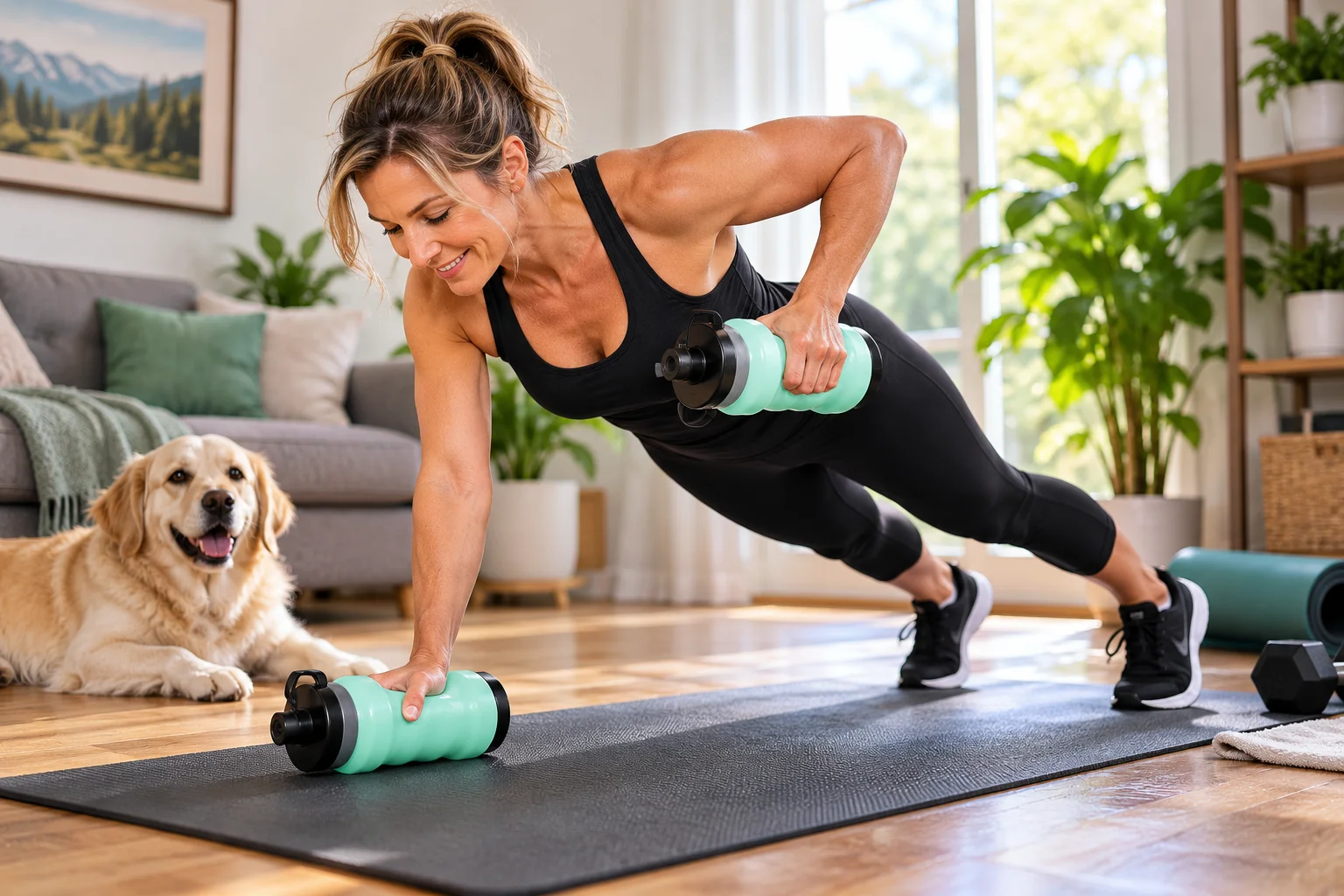
Depending on your fitness level, and available space, you could use your own body weight, dumbbells, kettlebells, resistance bands, a skipping rope, a stationary bike, or Weights2Go Weighted Sports Bottles.
For example, try this five-exercise circuit:
- Squats
- Burpees
- Press-ups
- Lunges
- Jumping jacks
You could work for around 30–45 seconds, followed by 15–30 seconds of recovery, before moving to the next exercise.
Repeat the circuit according to your fitness level, and how much time you have. Remember, you don’t have to exercise at maximum effort every time.
‘High intensity’ is relative to your own fitness level. If you’re new to HIIT, start gradually and give yourself enough recovery between intervals.
Prefer Cycling?
A stationary bike can be a great way to introduce HIIT, particularly if you prefer a lower-impact form of exercise. For example, you could cycle hard for around 20–30 seconds, followed by a longer period of easy cycling to recover.
Start with perhaps 4–6 intervals and gradually increase the number, or duration of your harder efforts, as your fitness improves. Cycling can also reduce the impact on your joints, compared with activities such as, running and jumping. A favourite playlist, can make the workout even more enjoyable!
What About Your Heart?
One of the main benefits of HIIT is its ability to improve cardiorespiratory fitness, essentially, how efficiently your heart, lungs and circulatory system, work during exercise.
Research consistently shows improvements in cardiorespiratory fitness following HIIT, and newer research suggests that even, relatively low-volume HIIT, can improve fitness, and may help to, reduce blood pressure. Because HIIT can be demanding, it isn’t necessarily suitable for everyone straight away.
If you’re new to exercise, start at a level that’s appropriate for your current fitness, and gradually build up. If you’re unsure, speak to a healthcare professional first.
HIIT Doesn’t Have to Be Complicated
One of the great things about HIIT is its versatility.
You can exercise at home, in your garden, at the park or almost anywhere you have enough space to exercise safely. You don’t need an expensive gym membership or lots of equipment.
You don’t have to make every workout HIIT. Combining cardiovascular exercise with resistance training, throughout your overall exercise routine, allows you to work on different aspects of fitness, including cardiovascular fitness, muscular strength, and body composition.
If you’re exercising outdoors with Weights2Go, the weighted sports bottles can add resistance to suitable exercises, while also giving you, water to stay hydrated.
Hydrate. Strengthen. Go.
The Takeaway
HIIT can be a fantastic addition to your exercise routine. It’s time-efficient, versatile and challenging, and, it can help to improve cardiovascular fitness, and, support overall health and fitness. You don’t need to push yourself to the limit every time you exercise.
Start at your own fitness level, take your recovery periods, and gradually, build from there.
Most importantly, find activities that you enjoy, and can perform safely. .
Disclaimer
The information provided in this article, and on this website, is for general educational and informational purposes only. It is not intended to replace medical advice, diagnosis or treatment from a qualified healthcare professional.
If you experience rapid or unexplained weight loss or weight gain, persistent abdominal swelling or bloating, significant changes in your bowel habits, abdominal pain, or any other symptoms that concern you, please speak to your doctor.
If you are new to exercise, have an existing medical condition, are taking medication, or are unsure whether a particular exercise, diet or weight-loss approach, is suitable for you, speak to your doctor or another appropriately qualified healthcare professional, before starting or changing, your exercise programme.
Research is continually evolving, and individual responses to diet, exercise, sleep and weight loss, can vary considerably.
Research & Further Reading
- Is low-volume high-intensity interval training a time-efficient strategy to improve cardiometabolic health and body composition? A meta-analysis — Yin et al., 2024. This meta-analysis included 21 studies and 849 participants and examined low-volume HIIT, cardiorespiratory fitness, blood pressure and body composition.
- Effectiveness of Whole-Body High-Intensity Interval Training on Health-Related Fitness: A Systematic Review and Meta-Analysis — Scoubeau et al., 2022. This systematic review and meta-analysis examined whole-body HIIT and outcomes including cardiorespiratory fitness, fat mass, fat-free mass and musculoskeletal fitness.
Higgins et al. (2023) — Systematic review and meta-analysis comparing HIIT with moderate-intensity continuous training for fat loss and cardiorespiratory fitness. This is the third study listed in your original article.