Life can certainly be stressful.
Moving house, changing jobs, financial worries, family responsibilities, relationship problems, and, simply having too much to do, can sometimes leave us feeling as though we’re juggling far too many, all things at once.
Stress itself isn’t necessarily a bad thing; it’s a natural response to challenges that can often motivate us, to take action. However, when stress becomes excessive or continues for a prolonged period, it can affect both our mental and physical wellbeing. We may find it harder to relax, concentrate, and sleep. It’s possible to, experience symptoms such as, headaches, irritability, tiredness, and or, an upset stomach.
So, what can we do when life feels overwhelming?
We can’t always remove the cause of our stress, but we can sometimes identify what’s causing it, and take small steps to look after ourselves.
Be Active
Exercise isn’t a magical cure for stress, but there is good evidence that it, and physical activity, can benefit our psychological wellbeing.
Going for a walk, heading out for a run, cycling, swimming, going to the gym, or simply getting outside and moving your body, can provide a welcome break from whatever has been occupying your mind.
A large 2023 overview of systematic reviews, involving more than 128,000 participants across 1,039 trials, found that physical activity was associated with improvements in depression, anxiety and psychological distress.
Even a short walk can be a useful way to step away from a stressful situation, and return, with a clearer head.
This is one reason I like combining movement with being outdoors.
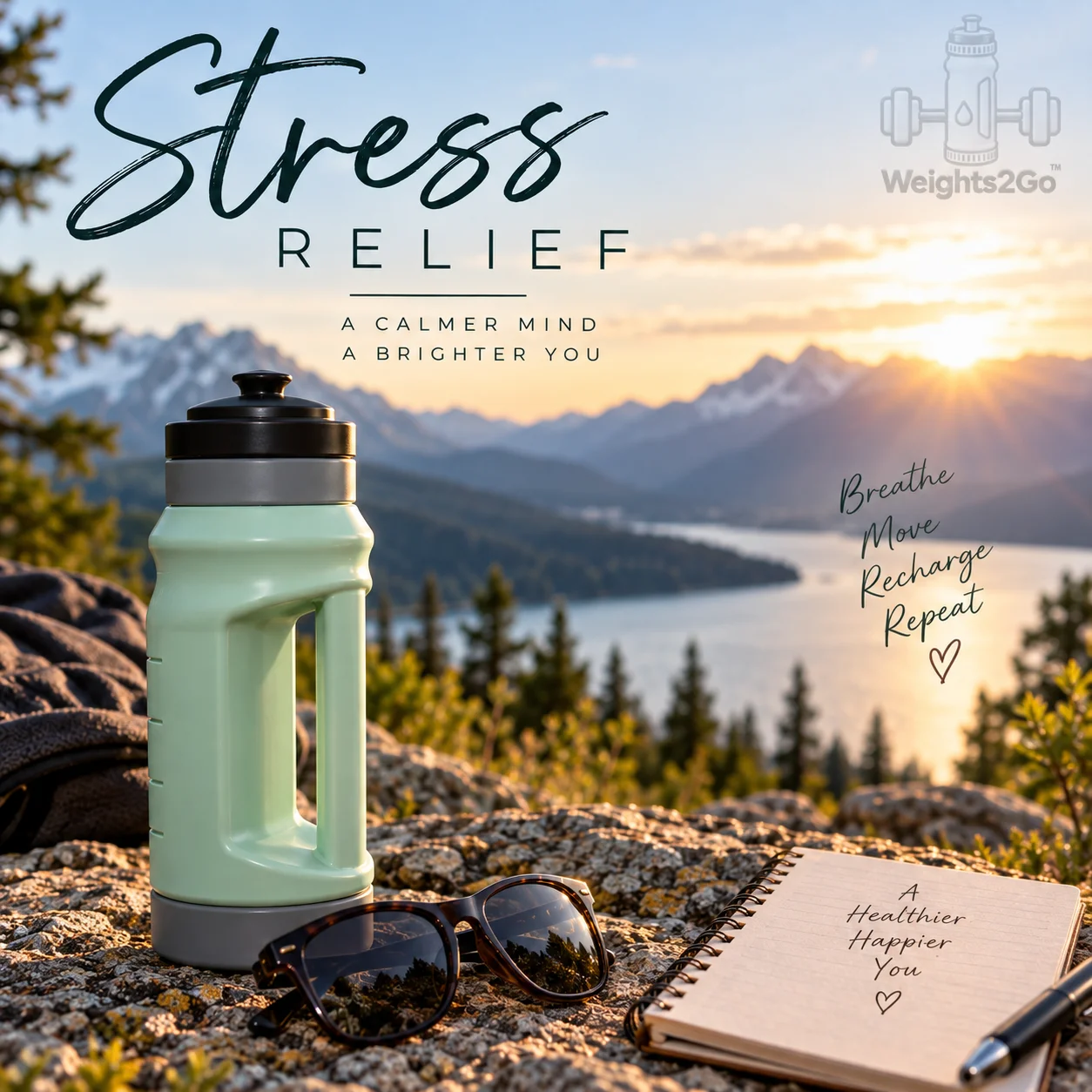
When Weights2Go comes to market, our Weighted Sports Bottles, will give you the opportunity to carry your hydration, while incorporating additional resistance, into activities such as walking, jogging, hiking, and, running.
Move your body, get some fresh air and give yourself a little time away from whatever is stressing you.
Connect With Others
When we’re stressed, it can be tempting to withdraw, and try to deal with everything, ourselves; but, you don’t always have to.
Call a friend, arrange a coffee, and maybe suggest going on a walk together. Have a laugh.
You don’t necessarily need to have a serious conversation about everything that’s bothering you. Sometimes, simply spending time with someone you enjoy being around, can make a difficult day feel seem a little brighter.
The World Health Organization also recommends maintaining connections with family and friends, as part of managing stress.
Focus on What You Can Control
When everything feels overwhelming, try separating the things that you can control, from the things that, you can’t.
Perhaps you can make one phone call, write a list, ask someone for help, or simply, decide what you’re going to do next.
You don’t have to solve everything today. Sometimes, taking one practical step is enough to get started.
Work Smarter, Not Harder
A never-ending To-Do List can make stress feel even worse.
Instead of trying to accomplish everything at once, ask yourself:
- What actually needs to be done today?
- What can wait?
- Can somebody help?
- Does everything on the list really need to be done?
Prioritise the important things and accept that, some tasks can wait until tomorrow. Putting something on tomorrow’s list isn’t failure, sometimes, it’s simply being realistic.
Having some structure to your day can also help you to feel more organised, and in control. The WHO recommends maintaining a daily routine and making time for activities such as exercise, recreation, family, and other, responsibilities.
Make Time for Yourself
This is an important one.
Your idea of “me-time” might be exercise, reading, listening to music, gardening, meeting friends, watching a movie, going for a walk, or sitting quietly with a cup of tea.
Whatever it is, try to make time for it, and, DO NOT feel guilty!
We often tell ourselves we’ll relax when everything has been done, but there will probably always be something to do.
If there’s an event or activity that you’ve been looking forward to, put it in your calendar, and protect that time, don’t cancel it.
You deserve some time to relax and recharge too.
Try Something Different
Learning something new, can provide a welcome change from your normal routine.
Try a new hobby, learn a language, cook a meal or bake a recipe that you’ve never made before, take a different walking route, or try a new form of exercise. It doesn’t have to be a major challenge. Often, doing something different, gives us a positive change, and a sense of achievement.
Practise Gratitude
When we’re stressed, it’s easy for our attention to become focused on everything that’s going wrong. One strategy is to think about, or write down, some people or parts of your life that you’re, grateful for. It can be significant, or simple, examples being:
- A beautiful morning
- A good night’s sleep
- A lovely walk
- A phone call from a friend
- A delicious meal
- Time with your family
- A few quiet minutes to yourself
Research into gratitude interventions suggests that there may be benefits, for some aspects of mental wellbeing, although the evidence isn’t strong enough to say that, gratitude automatically reduces stress for everyone. Think of it as one small tool rather than a solution.
Be Mindful of Your Coping Habits
When we’re stressed, it’s easy to reach for something that provides us with a quick feeling of relief, for example, an extra coffee, alcohol, smoking, pastries, or another, less-than-healthy habit.
Temporary relief doesn’t necessarily address the underlying stress, and some substances can potentially make certain symptoms worse. For example, a 2026 systematic review found evidence of a dose-dependent relationship between caffeine and anxiety in healthy individuals, although responses varied.
This doesn’t mean that you need to give up your morning coffee! However, if you’re already feeling anxious or stressed, it may be worth paying attention to how much caffeine you’re consuming, and whether it seems to, affect you personally.
Before automatically reaching for something that may not help in the long term, try something else first, eg, go outside, take a few deep breaths, listen to some music, call a friend or go for a walk.
Stop, Breathe and Get Outside
When we’re busy and stressed, it’s possible to become so caught up in what we’re doing that, we forget to stop. So, pause.
Take a breath, and relax your shoulders. Walk away from your desk. Step outside for a few minutes.
You don’t necessarily need an hour of meditation or a completely stress-free environment. The WHO’s Doing What Matters in Times of Stress guide includes simple techniques that can be practised for just a few minutes, at a time. If you have time, get outside.
Walk around the block. Take a short bike ride. Visit a nearby park. Go for a longer walk or hike.
Exercise and being outdoors won’t make every problem disappear, but they can provide a valuable break, and may help you to feel refreshed.
You don’t have to put every ball down; perhaps, just put one of them down, for a while.
Take a breath. Go for a walk. Call a friend. Do something you enjoy.
Most importantly, give yourself permission to take care of you!
Disclaimer
The information provided in this article, and on this website, is for general educational and informational purposes only. It is not intended to replace medical advice, diagnosis or treatment from a qualified healthcare professional.
If you experience rapid or unexplained weight loss or weight gain, persistent abdominal swelling or bloating, significant changes in your bowel habits, abdominal pain, or any other symptoms that concern you, please speak to your doctor.
If you are new to exercise, have an existing medical condition, are taking medication, or are unsure whether a particular exercise, diet or weight-loss approach, is suitable for you, speak to your doctor or another appropriately qualified healthcare professional, before starting or changing, your exercise programme.
Research is continually evolving, and individual responses to diet, exercise, sleep and weight loss, can vary considerably.
Research & Further Reading
World Health Organization — Doing What Matters in Times of Stress
A practical guide containing simple techniques for coping with stress that can be practised in just a few minutes.World Health Organization — Stress: Questions and Answers (2026)
Information about stress, its effects, and practical approaches including exercise, sleep, routines and connecting with others.
Read the WHO: Stress — Questions and Answers
Singh et al. — Effectiveness of physical activity interventions for improving depression, anxiety and distress (2023)
An overview of 97 systematic reviews involving 1,039 trials and 128,119 participants.
Read the study on PubMed
Komase et al. — Effects of gratitude intervention on mental health and well-being among workers (2021)
A systematic review examining gratitude interventions and their effects on mental health and wellbeing.
Read the study on PubMed
Nascimento et al. — The Effects of Caffeine on Anxiety Behavior in Healthy Individuals (2026)
A systematic review examining the relationship between caffeine consumption and anxiety in healthy individuals.
Read the study on PubMed
World Health Organization — Doing What Matters in Times of Stress
A practical guide containing simple techniques for coping with stress that can be practised in just a few minutes.
Read the WHO guide